Why fixed transaction fees drain merchant revenue (ROI calculator)
Every credit card processor advertises their percentage fee in bold print. The fine print—the fixed cents per transaction—is where margins quietly disappear.
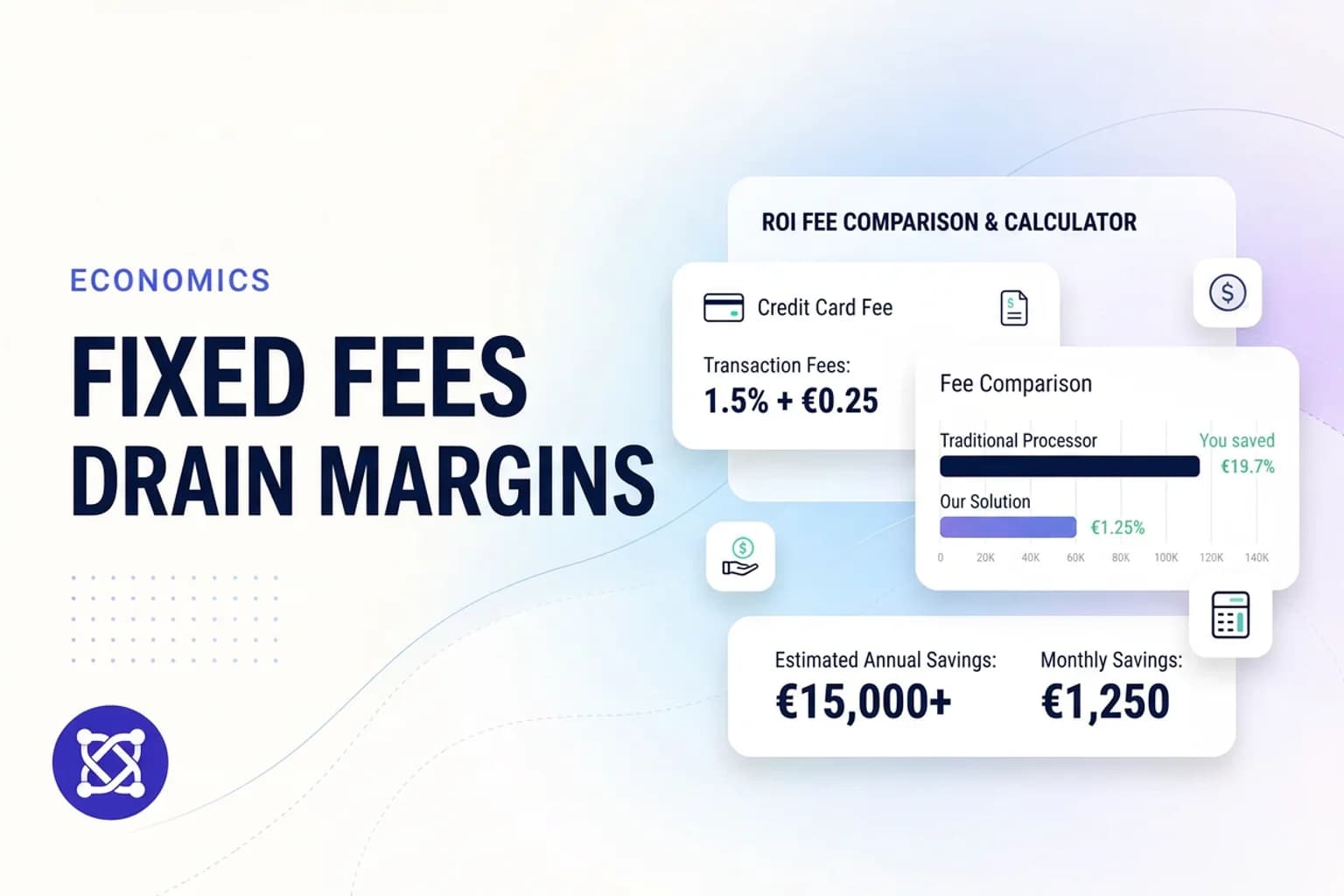
Credit card pricing looks deceptively predictable: 1.4% + €0.25 for European cards, or 2.9% + $0.30 for international cards. On large orders, that fixed surcharge is negligible. But commerce is shifting toward lower ticket sizes, subscription top-ups, and automated machine-to-machine payments.
When an AI agent or software workflow triggers dozens of €5 to €25 purchases each month, fixed fees compound into a major tax on your operating margin.
The mechanics of fixed fee drag
Consider three transaction sizes processed through a standard 1.5% + €0.25 processor rate:
| Order Value | Percentage Fee (1.5%) | Fixed Surcharge | Total Processor Fee | Effective Fee Rate |
|---|---|---|---|---|
| €150.00 | €2.25 | €0.25 | €2.50 | 1.67% |
| €25.00 | €0.38 | €0.25 | €0.63 | 2.52% |
| €5.00 | €0.08 | €0.25 | €0.33 | 6.60% |
At €5.00, the fixed fee alone represents 5% of the gross sale. The merchant loses nearly 7% of gross transaction value before considering refund reserves or monthly software subscriptions.
Interactive ROI & Fee Calculator
Use the interactive calculator below to model your business's monthly transaction volume and average ticket size against traditional card processors versus GenesisPay's 1% rate (with a minimum fee of at most €0.01 per payment, adjusted to network costs):
Interactive Processing Fee & ROI Calculator
See what fixed fees do to your bottom line.
GenesisPay charges 1% per payment, with a minimum fee of at most €0.01 (adjusted to network costs), never more than half of the payment. Compare your estimated annual costs below.
€240,000 / year · 3,000 payments
Estimated annual savings with GenesisPay: €1,950 compared to Processor A.
For illustration purposes only. GenesisPay charges 1% per payment on settled Base transactions, with a minimum fee per payment of at most €0.01 (adjusted to network costs), never more than half of the payment. Traditional card rates reflect standard EU merchant tariffs including fixed per-swipe fees.
Why AI agents break the traditional fee model
AI agents don't browse and buy like humans. Instead of consolidating items into a single large shopping cart once a week, autonomous agents execute granular, continuous transactions:
- Purchasing individual API tokens or query quotas on demand.
- Paying for dynamic computation, bandwidth, or file storage in real time.
- Booking reservations, tickets, or service requests the moment optimal pricing appears.
If an autonomous shopping agent buys three related items from different vendors for €8 each, a traditional merchant pays €0.75 in fixed fees alone across the three checkouts.
With non-custodial stablecoin settlement on Base (USDC and EURC), transactions settle directly peer-to-peer on Layer 2 in ~3 seconds. Because L2 gas costs are fractions of a cent, GenesisPay charges 1% per payment with a minimum fee that follows network costs and never exceeds €0.01, never more than half of the payment, instead of a fixed surcharge on top of the percentage.
Primary sources
Check the original sources.
Last source review: Oct 1, 2026. This is technical education, not financial or legal advice.